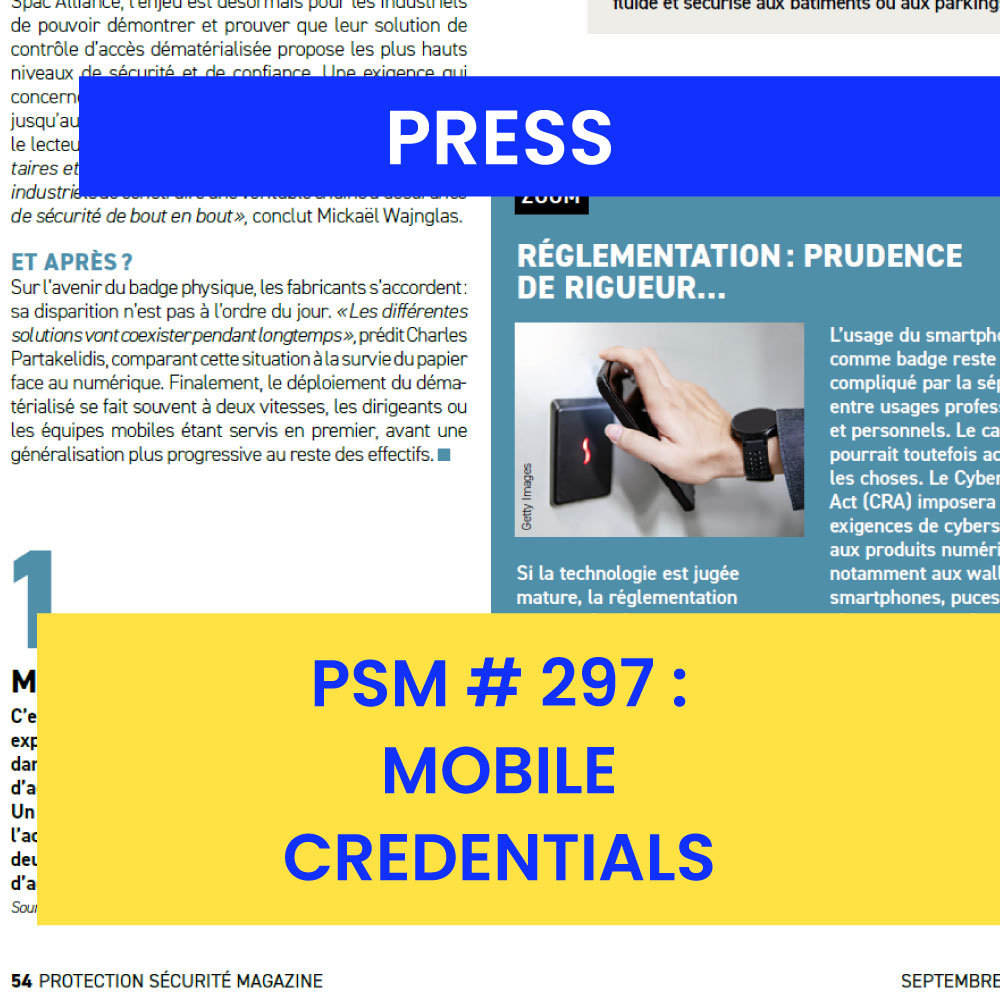
In its September-October 2026 issue (No. 297), Protection Sécurité Magazine explores the shift to mobile access credentials. Entitled “A revolution taking its time”, the feature brings together perspectives from manufacturers, integrators and end users, including SPAC Alliance and several of its members. The original feature is available in French.
Visitor management, remote provisioning of access rights and integration with digital wallets: mobile credentials open up new possibilities. Their deployment also raises questions about compatibility, cost, cybersecurity and the use of personal smartphones for work. The contributors examine both the practical benefits and the conditions for successful adoption.
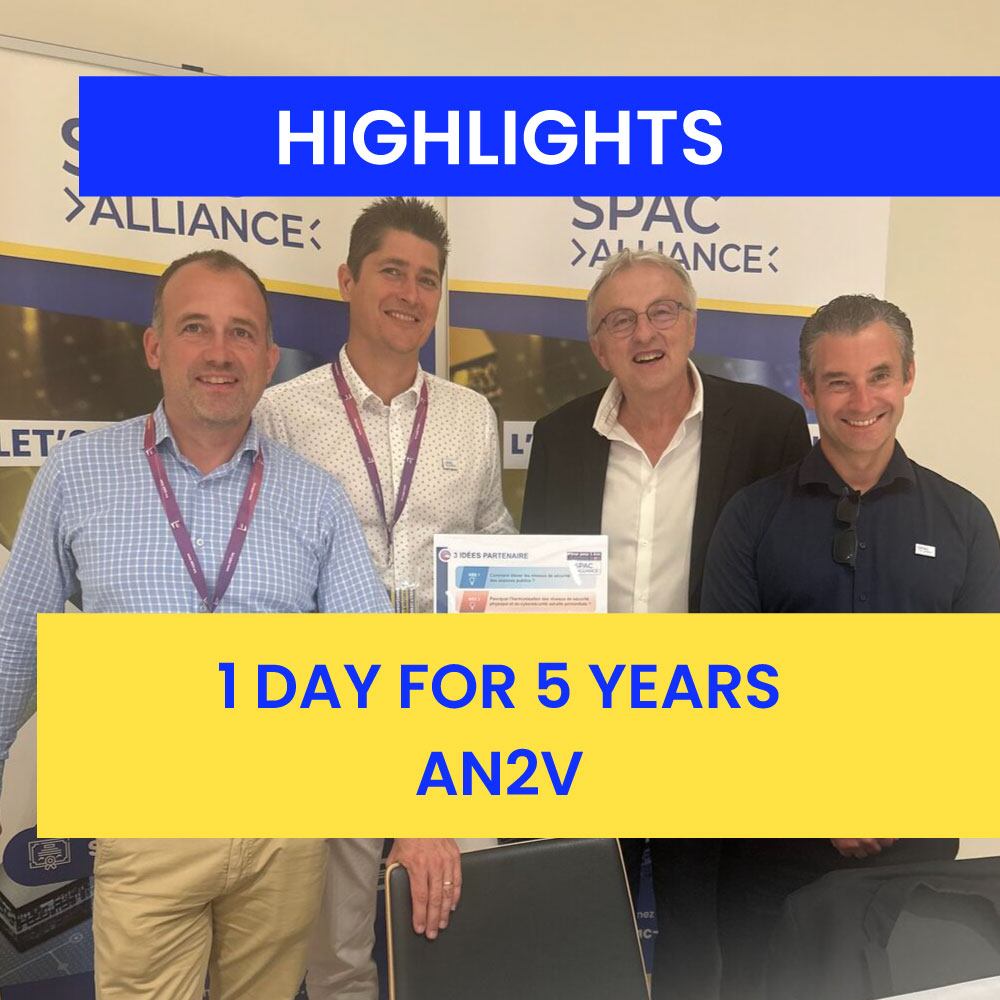
For Mickaël Wajnglas, Secretary General of SPAC Alliance, the priority is to provide evidence of security across the entire access control chain. This encompasses the smartphone, reader, controller and access control system. Manufacturers must be able to substantiate the level of protection and trust their solutions offer across these connected components.
“The evolution of regulatory frameworks and certification schemes should enable manufacturers to build a true end-to-end chain of security assurance.”
His contribution places the Cyber Resilience Act (CRA) within this broader effort to strengthen confidence in digital products. It also identifies the European Digital Identity Wallet under eIDAS 2 as an opportunity for the access control ecosystem.
Several SPAC Alliance members explore complementary aspects of this transition:
- FDI: simplifying access for visitors and contractors. Maxime Gelin highlights the value of mobile credentials for visitors, service providers and temporary staff. A maintenance technician, for example, can receive access rights before arriving on site. He explains FDI's decision to develop LiNEGUARD Access, its own proprietary application, with simpler deployment as a key objective. The feature also presents the solution's combination of NFC badge emulation and Bluetooth Low Energy, alongside FDI's support for credentials stored in Apple and Google wallets.
- SimonsVoss: supporting a gradual transition. Charles Partakelidis expects physical and mobile credentials to coexist for a long time. Adoption depends on subscription costs, company policies and employees' acceptance of work applications on personal smartphones. He also stresses that no solution can promise zero risk. On the technology side, the feature presents the integration of STid Mobile ID into SmartIntego, bringing Bluetooth Low Energy mobile access to battery-powered cylinders and electronic door fittings, with access rights that can be updated or revoked remotely.
- Nedap: considering the full cost of credential management. Baudouin Genouville draws attention to the work behind a physical badge: encoding, printing, issuing replacements, managing temporary credentials and keeping track of lost or inactive cards. These tasks consume staff time, equipment and budget. He sees mobile credentials as a way to streamline these activities and reduce the associated workload. The feature also presents Nedap Mobile Access, which integrates credentials into Apple and Google wallets for use on compatible smartphones and smartwatches.
- Onet Sécurité Systèmes: assessing how mobile access changes risk. Martin Renard offers a balanced assessment: mobile credentials introduce new risks while helping to reduce others. He highlights the additional authentication involved in unlocking a smartphone as a potential security benefit. His contribution encourages readers to consider how the move to mobile changes the overall risk profile, including the protections it can add.
- Dény Security: making remote access management practical. Tony Martins describes how Tapkey digital keys allow access rights to be assigned remotely, with permissions tailored to specific doors, time slots and validity periods. In hospitality and tourism, guests can receive their credentials before arrival and access their accommodation independently, using a compatible smartphone or smartwatch. He also notes two practical limits: not all employees have company-issued smartphones, and some environments prohibit smartphone use. These constraints must be considered when choosing how to deploy mobile access.
Read SPAC Alliance and its members' contributions in French on pages 51 to 54 of Protection Sécurité Magazine, issue 297.