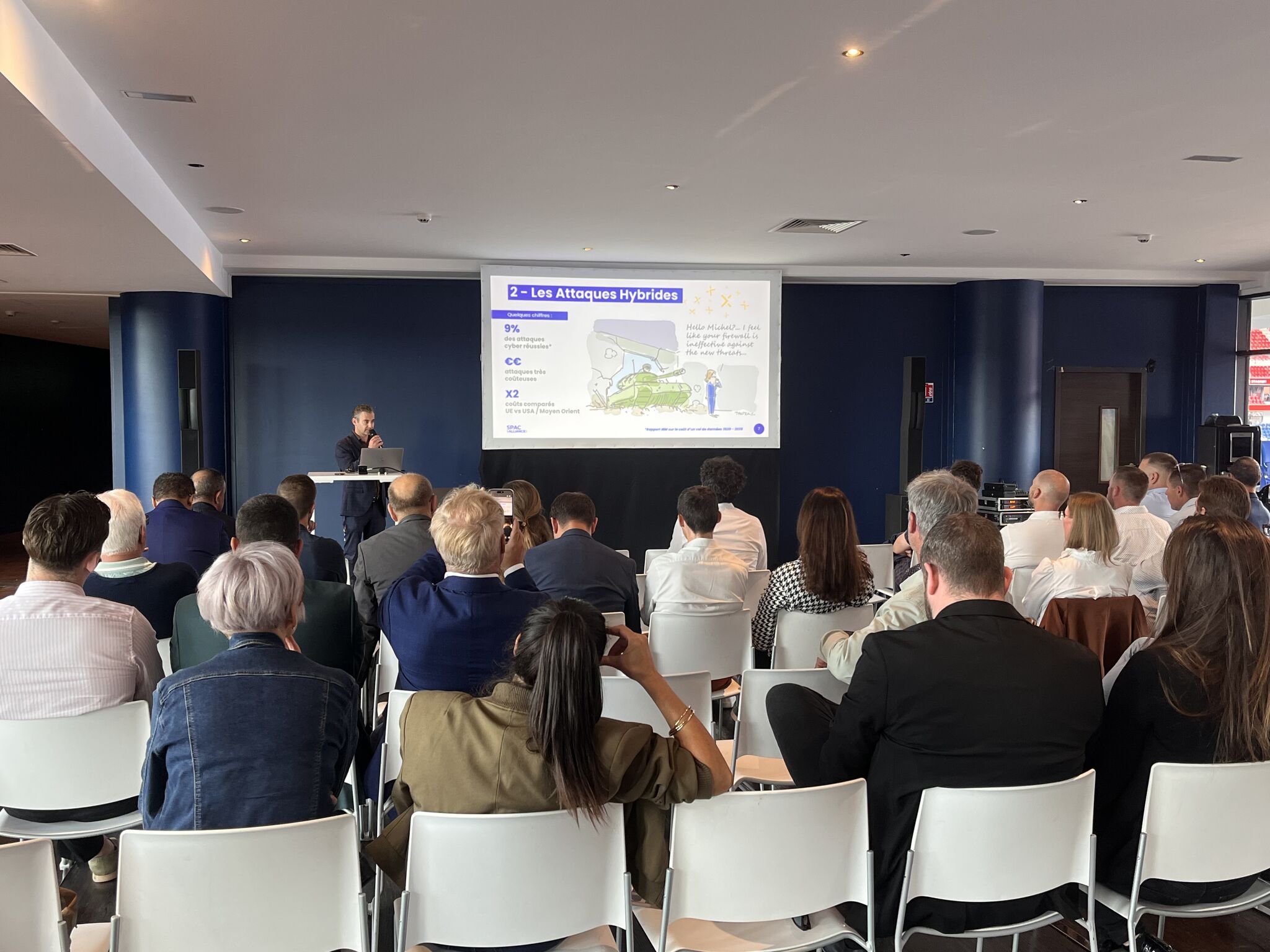
SPAC Alliance, represented by Mickaël Wajnglas, took part in the Lyon edition of CRITIQ Jours 2026, at the invitation of Denis Castanet from Advancis Software & Services.
On this occasion, Mickaël delivered a conference on “Cybersecurity and compliance: ANSSI requirements in relation to the NIS 2 and CER directives”, addressing safety and security managers from critical organisations.
Cybersecurity, compliance and resilience: one shared challenge
In a context marked by intensifying cyber threats, the implementation of European regulatory obligations and the growing complexity of operational environments, this Lyon edition of CRITIQ Jours 2026 brought together public and private decision-makers, technical experts and industry players.
The SPAC Alliance conference provided an opportunity to review the challenges associated with the NIS 2 Directive, the CER Directive and the frameworks and guidance issued by ANSSI (see our ReCyF guide), with a clear objective: helping the organisations concerned to better understand their obligations, anticipate their compliance roadmap and structure their preparation.
Resilience must be demonstrated
The event once again highlighted that resilience depends on the quality of the link between physical security and cybersecurity, as well as on organisations’ ability to ensure business continuity and recovery.
For critical entities, these resilience objectives also require organisations to take into account the full spectrum of physical and hybrid threats, including terrorism, malicious acts, climate-related hazards and geopolitical crises that may have an impact on operations.
These responses must be documented and operational: identification, implementation, testing and continuous improvement.
High security must be built on open standards and sovereign technologies.
In this context, access control, supervision, video protection and security communication systems are becoming essential components of overall resilience. But beyond the security level of a given solution, other parameters also come into play: deployment quality, governance and even technology choices.
This is why open and interoperable standards such as the SSCP protocol are increasingly relevant: they help limit dependency on third parties and gradually contribute to genuine security sovereignty in Europe.
Mobilising the security ecosystem
The discussions underlined the importance of close cooperation between end users, integrators, manufacturers, software publishers and institutions. In the context of the NIS 2 and CER directives, and as the threat landscape becomes increasingly complex, cooperation across the entire security ecosystem is more important than ever.
We would once again like to thank Advancis Software & Services for the invitation, our members STid and COMMEND France for their support, as well as the other partners present: barox Kommunikation, OPTEX France and Dallmeier electronic.