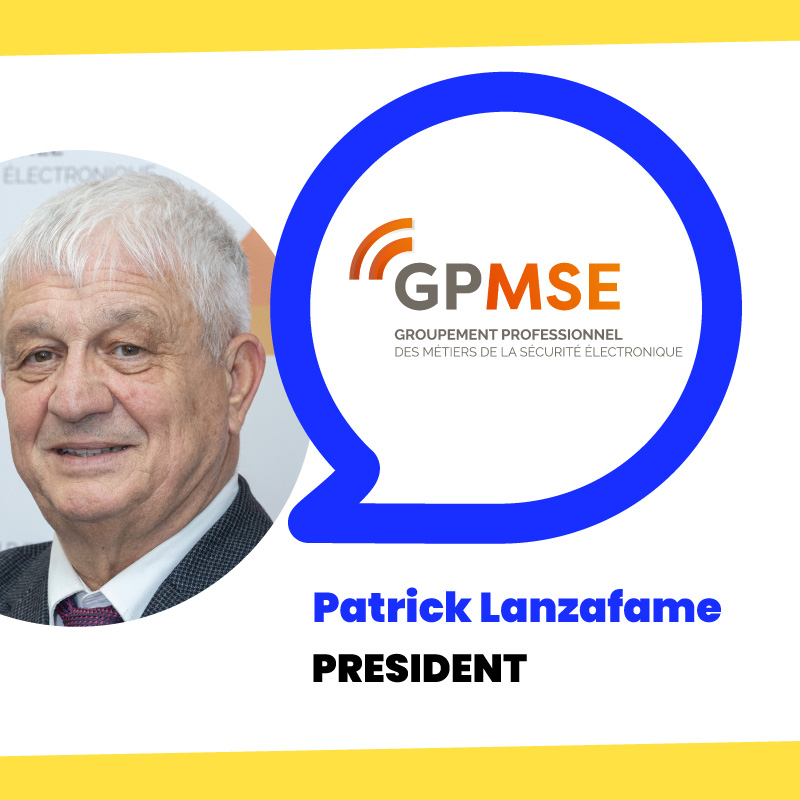
“Together, SPAC Alliance and GPMSE will be better placed to prepare for European regulations, contribute to standardisation efforts, promote open standards such as SSCP and champion a European approach built on interoperability and digital sovereignty.”
Patrick Lanzafame – President of GPMSE
Could you introduce GPMSE, its mission and the professions it represents?
GPMSE is the trade association representing the electronic and digital security sector in France. Established in its current form in 1998, with roots in industry representation dating back to 1979, it now brings together 145 member companies across more than 250 sites, accounting for 16,200 employees and approximately €1 billion in revenue.
Our members span the entire value chain: security system installation and maintenance, remote alarm monitoring, video surveillance, access control, remote services and digital technologies.
Our mission is to bring the industry together, represent its interests before public authorities and support it through change. We keep our members informed about developments in regulations, standards, employment matters and technology, while promoting their professions, expertise and professional ethics.
GPMSE also provides a forum for discussion and collective thinking, helping the industry prepare for tomorrow’s key challenges, including artificial intelligence, cybersecurity, the IoT and new uses of data.
What does GPMSE stand to gain from joining SPAC Alliance?
This partnership reflects the growing convergence between electronic security and cybersecurity. Devices are now connected to corporate networks, the cloud and a wide range of digital services, making the protection of communications and data an integral part of physical security.
GPMSE primarily represents installers, integrators and remote alarm monitoring companies, while SPAC Alliance brings together manufacturers, software vendors, institutional bodies and cybersecurity experts. Our complementary strengths allow us to cover the entire value chain and share our expertise. Together, we will be better placed to prepare for European regulations, contribute to standardisation efforts, promote open standards such as SSCP and champion a European approach built on interoperability and digital sovereignty.
For our members, this partnership should also deliver tangible benefits: more actionable information, access to technical working groups, the development of training programmes and better preparation for cybersecurity requirements in both public and private sector contracts.
What benefits can the SSCP protocol bring to the security market?
First and foremost, SSCP provides stronger cybersecurity for communications between devices. Mutual authentication, encryption and message integrity protection help prevent interception, data tampering and replay attacks. Its value, however, extends beyond securing communications.
As an open standard, SSCP promotes interoperability between devices from different manufacturers and reduces users’ reliance on proprietary solutions. This makes installations easier to upgrade and maintain over the long term, while enabling new applications in access control, intrusion detection, video surveillance, intercom systems and connected devices.
Against a backdrop of increasingly demanding regulatory requirements, the protocol helps build more secure, open and durable systems, while supporting a sovereign European technology ecosystem.
What role should training play in bringing together electronic security, services and compliance?
Training is a cornerstone of this process, connecting technological advances, service quality and compliance. As IP technologies, cloud computing, the IoT, artificial intelligence and cybersecurity develop, roles across the industry are changing rapidly.
Installers, technicians, integrators and remote service operators need to acquire new skills and keep them up to date throughout their careers. This is precisely the purpose of GPMSE Formation, our training organisation dedicated to electronic security systems and related services, particularly remote alarm monitoring, video surveillance and remote services.
Training not only enables professionals to master new technical architectures, but also helps them embed regulatory requirements and cybersecurity best practices into their day-to-day work. It should therefore be seen as more than an obligation: it is a strategic investment that makes working practices more secure, accelerates innovation, strengthens professional expertise and builds lasting customer trust.
How should the security market view standards and certifications?
Standards and certifications should be seen as more than administrative requirements. They are drivers of trust, quality and competitiveness across the market. Standards establish a common baseline for performance, reliability and security, while certifications provide independent verification of conformity for a product, service or company. They offer reassurance to customers, insurers and commissioning organisations, particularly where sensitive sites or critical infrastructure are concerned.
They also play a vital role in interoperability, facilitating the integration of devices from different manufacturers and helping prevent lock-in to proprietary solutions.
Furthermore, in an environment shaped by NIS2, the Cyber Resilience Act and the proliferation of connected devices, they provide a recognised framework for demonstrating compliance and strengthening cybersecurity.
They are thus becoming a common language shared by manufacturers, integrators, operators, certification bodies and public authorities, as well as a decisive advantage when competing for tenders and demonstrating a company’s professionalism.